

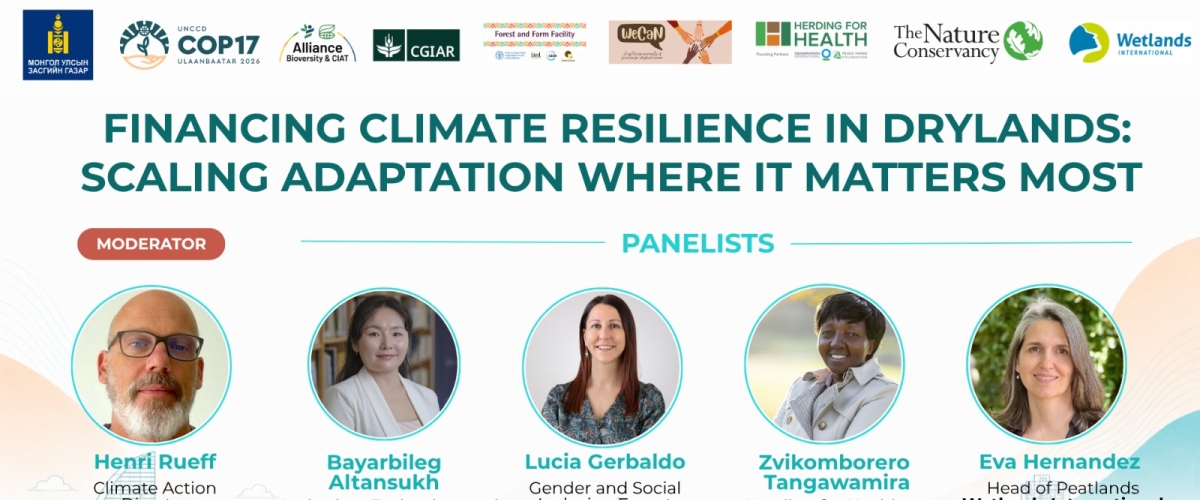
The session, “Financing Climate Resilience in Drylands: Scaling Adaptation Where It Matters Most,” brought together specialists from finance, research, conservation and programme implementation to explore how blended finance, nature-based solutions, scientific risk tools and stronger community engagement can unlock investment in drylands.
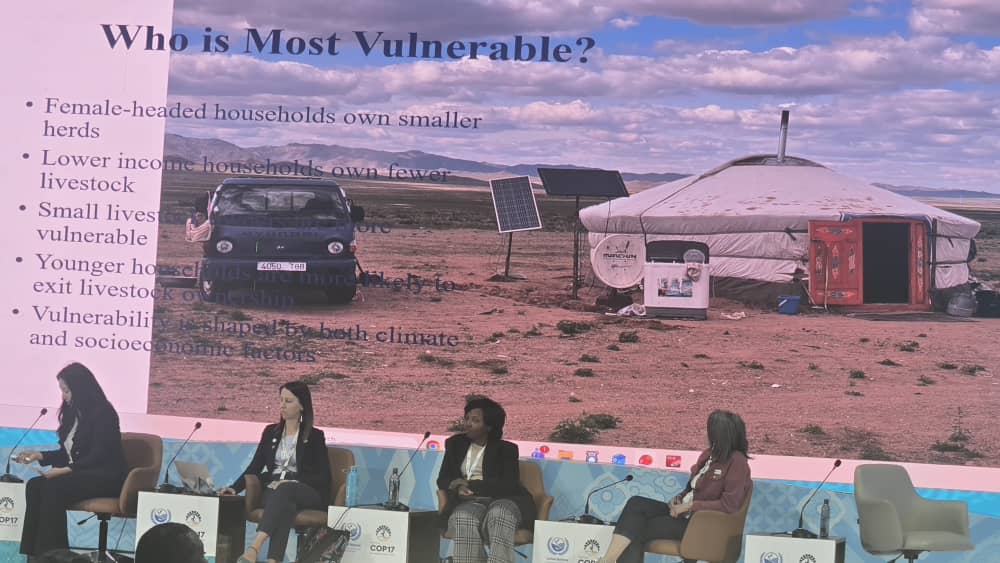
Among the panellists was Ms. Zvikomborero Tangawamira, Herding for Health Programme Manager at Peace Parks Foundation and Conservation International, who presented Herding for Health as a practical and scalable model for investing in Africa’s rangelands and pastoralist communities. Ms. Tangawamira highlighted the scale of the challenge facing the continent. Africa’s rangelands sustain wildlife, store carbon and support the livelihoods of more than 268 million people, yet over 700 million hectares are degraded. As these landscapes deteriorate, the effects spread beyond the environment. Degradation reduces livestock productivity, weakens food security, accelerates biodiversity loss, increases human–wildlife conflict and leaves rural communities more exposed to climate shocks.
Building a case for investment
Herding for Health, a joint initiative of Conservation International and Peace Parks Foundation, works with pastoralist communities to restore rangelands, improve livestock health, strengthen livelihoods and establish effective governance systems.
The programme currently operates across 17 landscapes in seven African countries, with more than one million hectares under improved management. It has reached over 3,300 pastoralists, supported more than 20,000 direct beneficiaries and created over 2,200 nature-positive jobs.
Ms. Tangawamira explained that investing in rangeland restoration should not be viewed only as environmental spending. When properly designed, it can establish the conditions needed for stronger livestock enterprises, improved market access and higher household incomes.
The Herding for Health approach begins with philanthropic and public financing to support community organisation, planned grazing, livestock health, governance and landscape restoration. As rangelands and livestock become healthier, productivity improves and communities are better positioned to access formal markets.
More mature enterprises can then attract concessional loans, first-loss guarantees and, eventually, private debt or equity. Carbon revenue may provide an additional financing opportunity where credible monitoring and verification systems are in place. The programme has helped mobilise more than US$150 million in grant finance, while improved market access has generated over US$8.4 million in revenue. The figures demonstrate that restoring drylands can produce measurable environmental and economic value. However, Tangawamira stressed that reaching this level requires sustained investment in the foundations that make enterprises viable.
Governance and trust come first
Financing alone will not transform dryland landscapes. Ms. Tangawamira identified functional governance, trust, reliable evidence and simple monitoring, reporting and verification systems as essential conditions for scaling investment.
Local institutions must be capable of managing shared grazing resources, enforcing agreed practices and ensuring that benefits are distributed fairly. Investors, governments and communities must also trust one another and have access to evidence showing whether the land, livestock and livelihoods are improving. The programme’s four pillars, restored rangelands, healthy animals, thriving livelihoods, and strong governance and enabling policies, reflect the interconnected nature of dryland resilience. Progress in one area depends on progress in the others.
The wider panel included Bayarbileg Altansukh of The Nature Conservancy, Lucía Gerbaldo of the Forest and Farm Facility, and Eva Hernandez of Wetlands International. Henri Rueff, Climate Action Director at the Alliance of Bioversity International and CIAT, moderated the discussion. Together, the panelists brought perspectives from monitoring and learning, social inclusion, conservation, climate science and program implementation. Their participation reflected the partnerships required to move adaptation finance from high-level commitments to locally relevant action.
The discussion also challenged the tendency to treat drylands as landscapes separate from wetlands and water systems. Ms. Eva Hernández emphasised that wetlands are essential to the survival and resilience of drylands because they store and regulate water. “There are no drylands without wetlands—water comes from wetlands. Wetlands regulate water: by holding it, they buffer floods and reduce erosion; by releasing it later, they buffer droughts.”Drawing on examples from Mongolia, Peru and Ethiopia, Hernández explained that wetlands support livelihoods and that approximately one billion people depend directly on them. Yet an estimated 22 percent of wetlands have been lost since 1970, in addition to losses that occurred before reliable records were available. She said investment decisions must begin with an understanding of how the wider landscape captures, stores and releases water. This requires identifying all stakeholders with interests in the landscape, including those located outside the immediate project area. It also calls for investment in knowledge and co-creation, bringing local knowledge and priorities together with scientific and technical expertise.
Ms. Hernández further urged countries to recognise the multiple ecological, social and economic benefits provided by wetlands and to integrate wetlands more deliberately into Land Degradation Neutrality targets and implementation plans. However, panellists stressed that increasing climate finance alone would not guarantee inclusive outcomes.
Ms. Lucía Gerbaldo, Gender and Development Specialist, said gender-responsive finance must also address decision-making power. “Gender-responsive and inclusive climate adaptation finance is not simply about getting more money into the hands of women and small producers. It is about changing who has the power to set priorities, negotiate terms, decide how resources are invested and share in the benefits.” Gerbaldo explained that women and small-scale producers frequently face barriers long before they reach a financial institution. “In some contexts, the first step is to address the barriers that come before formal access to finance itself: ensuring women have an identity document, a bank account in their own name, basic financial literacy and the ability to negotiate directly with a financial institution or buyer. Without these foundations, inclusive finance risks remaining out of reach.”
The session delivered a clear message: Africa’s drylands are not unproductive spaces waiting for aid. They are economically and ecologically important landscapes that can generate food, income, biodiversity and climate benefits when communities receive the right support. For programmes such as Herding for Health, the investment case begins with the people who manage these landscapes every day. When pastoralists have secure partnerships, functioning governance structures, healthier livestock and access to markets, climate adaptation becomes more than a project—it becomes a pathway to lasting economic resilience.
The IKI Growing Greener programme is funded by the German Federal Ministry for the Environment, Climate Action, Nature Conservation and Nuclear Safety through the International Climate Initiative (IKI). Its consortium partners are GIZ, CCARDESA, Peace Parks Foundation and Conservation South Africa.


